


Common Misconceptions Newcomers Have About Work vs. Immigration Pathways

Many newcomers assume that immigration pathways and career pathways are the same thing. In reality, they are connected—but they serve very different purposes.
Subscribe to our blog and Newsletter to read Topics like "Common Misconceptions Newcomers Have About Work vs. Immigration Pathways" where we address a common misconception -
“Doing any ‘survival job’ now won’t affect my long‑term trajectory.”
Newcomers are often told “just get any job,” assuming they can easily pivot later. But long periods in low‑skill roles can delay credential recognition, reduce time and energy for upskilling, and trap people in sectors with few progression opportunities, which is a key driver of dissatisfaction and secondary migration.
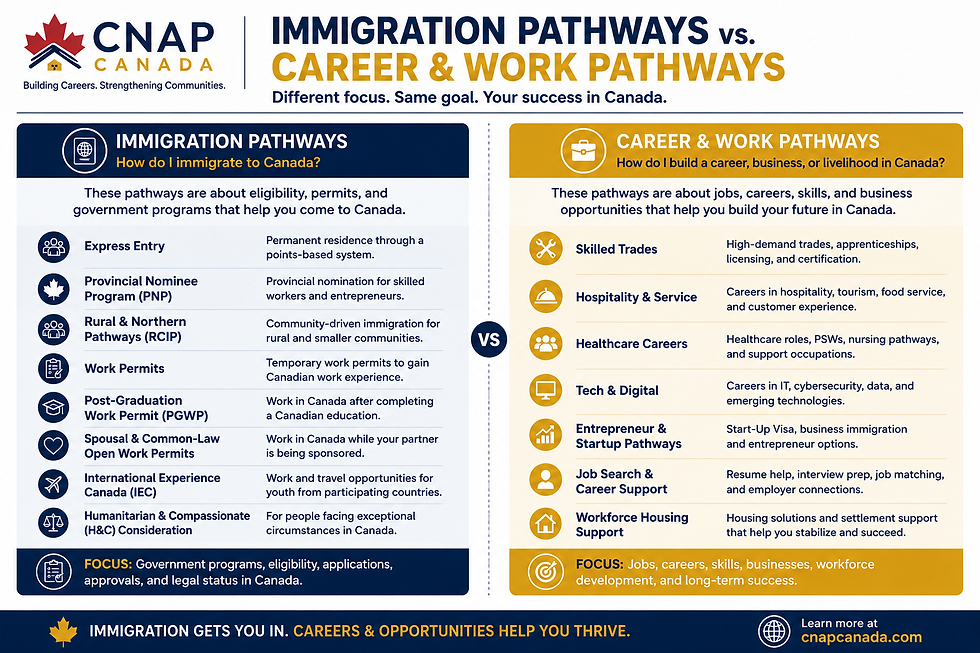
Misconception #1: If I qualify for immigration, I will automatically find a job.
Immigration programs assess eligibility for entry to Canada. They do not guarantee employment.
A person may qualify for permanent residence but still need to build Canadian work experience, obtain licensing, improve language skills, or develop a job search strategy.
Misconception #2: My occupation is on an immigration list, so employers will be waiting to hire me.
Being eligible under an immigration pathway and being competitive in the labour market are two different things.
Employers hire based on skills, experience, licensing requirements, location, and business needs—not simply because an occupation appears on an immigration program list.
Misconception #3: Work permits and careers are the same thing.
A work permit gives you authorization to work.
A career pathway focuses on building long-term employment, income stability, professional growth, and future opportunities.
One is a legal document. The other is a long-term plan.
Misconception #4: Immigration planning is enough.
Successful settlement often requires three separate plans:
• Immigration Plan• Employment Plan• Housing Plan
When one of these pieces is missing, newcomers may face unnecessary challenges after arrival.
Misconception #5: Housing comes after employment.
Housing and employment are often connected.
Job opportunities may exist in locations where housing is limited, expensive, or difficult to secure. Understanding both factors together helps newcomers make more realistic decisions.
Misconception #6: Every pathway is right for everyone.
Canada has many immigration and workforce pathways. The goal is not to pursue every option.
The goal is to identify the pathway that best aligns with your skills, experience, family situation, goals, and timeline.
The CNAP Approach
At CNAP, we encourage newcomers to look at the full picture.
Immigration is one part of the journey.
Employment, workforce development, housing stability, and long-term economic success are equally important.
Understanding how these pieces work together can help newcomers make more informed decisions and build a stronger foundation for life in Canada.


Comments